

Sintetica 2.0
A real-time generative organism shaped by the world’s information streams.
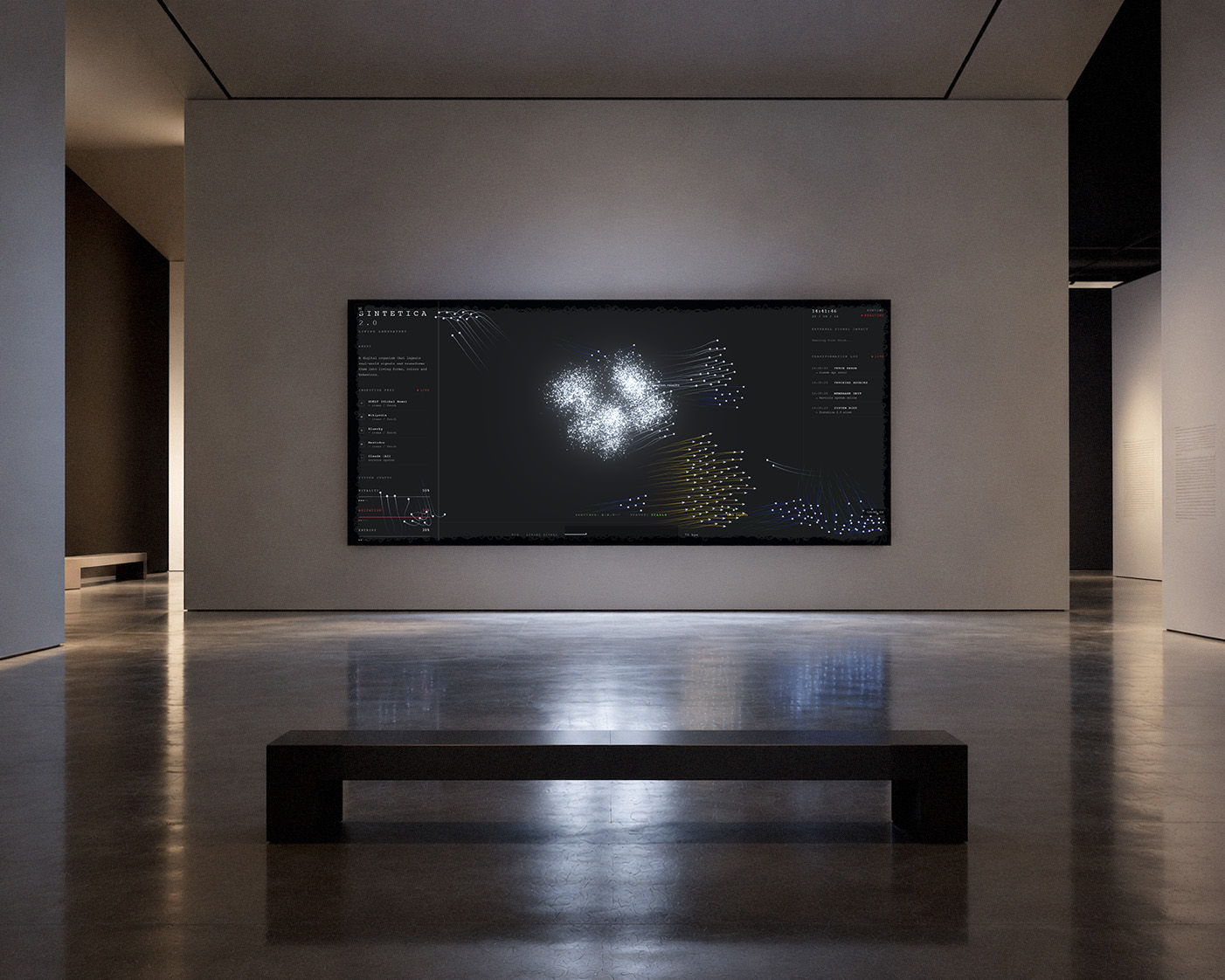
WHAT IT IS
SINTETICA is a digital organism that exists entirely online, generated in real time by code. It continuously reads live data from the world’s information streams, interprets their emotional charge through an artificial intelligence model, and translates that reading into a body: a cloud of particles with a heartbeat, a breathing rhythm, colour, and behaviour that change as the world changes. It is not a fixed image but a system that runs perpetually and is never twice the same.
THE QUESTION
The project begins from a question. Every second, humanity produces an enormous collective record of what it thinks, fears, and celebrates. What would it mean to give that record a body, and an emotional state? And what do we see about ourselves when a non-human intelligence is made to read our news and respond to it? Sintetica is an attempt to make the emotional temperature of the present moment visible and, briefly, addressable.

HOW IT WORKS
The organism is fed by four live data streams, each capturing a different layer of the present:
- GDELT — real-time global news indexed from thousands of sources worldwide.
- Wikipedia — the articles being edited at this very moment, a live map of collective attention.
- Bluesky — the most popular public posts, raw and emotional fragments people write in the open.
- Mastodon — the trending public statuses across the federated network.
Roughly every thirty minutes the system collects fresh fragments and passes them to Claude, a language model acting as the organism’s nervous system. Claude assigns every fragment a sentiment score from 0.0 (catastrophic) to 1.0 (radiant) and identifies the dominant themes of the moment. These values drive the organism’s colour, heart rate, breathing speed, and overall state.

Sintetica does not learn, and it does not possess consciousness. It is a reactive system, orchestrated in real time; its “emotions” are a designed translation of measured sentiment into form. The honesty of that translation — the refusal to fake an interiority it does not have — is part of the work.
SENTIMENT AND FORM
The measured sentiment of the world is translated, deterministically, into the appearance and behaviour of the body. The mapping is designed rather than learned, which makes the organism legible: to read Sintetica is to read the emotional state of the present, written in light.

BEHAVIOUR AND LIFE STATES
The organism breathes at a rate set by the world’s agitation, its electrocardiogram tracing a living signal at the base of the screen. Negative events leave bleeding red traces that fade like short-term memory. As it drifts and rotates, its movement paints a persistent canvas of coloured traces — a self-generated drawing of the period it has lived through.
Sintetica is not eternal. Under sustained extreme conditions it can die and be reborn; under rare radiant ones it can reproduce, generating a smaller autonomous organism. These thresholds are part of its biology and remain undisclosed.

INTERACTION
During exhibitions, visitors scan a QR code and speak to Sintetica from their own phone. It listens, and answers live on the large screen, in the voice of a non-human intelligence: detached, occasionally tender, never servile. The encounter completes the work — the data, the code, the screen, and the person standing in front of it become a single event.
CONTEXT
Sintetica situates itself within the traditions of artificial life and generative art — a lineage that treats code as a living, autonomous material rather than as a tool for producing fixed images. It extends this lineage toward the real-time data of the present, asking what kind of organism the contemporary information ecosystem would produce if it were given a body.
CREDITS
Concept, direction, and artwork: Giuseppe Lo Schiavo.
Sentiment interpretation: Claude (Anthropic), acting as the organism’s nervous system.
Data sources: GDELT, Wikipedia, Bluesky, Mastodon.
Sintetica originates from the artist’s participation in the BioArt Challenge of ACDC — Artificial Cells with Distributed Cores, a European Horizon 2020 research project (Grant Agreement No. 824060). Giuseppe Lo Schiavo undertook a year-long research residency (2021–2022) developing a speculative artwork in dialogue with the project’s scientists, following their research at the intersection of synthetic biology and artificial life. The residency included work at the Laboratory for Artificial Biology (Hanczyc Lab) at the University of Trento and was facilitated by MUSE — Museum of Science, Trento. The first version of Sintetica drew on microscopy footage of artificial cells recorded during this research; Sintetica 2.0 extends the same question — whether life can be found in the flow of data — into a fully digital organism.